Owner's Manual
Basic Care
The practical guide we hand every family at pickup — feeding, training, movement, grooming and the spine care that matters more in this breed than any other.
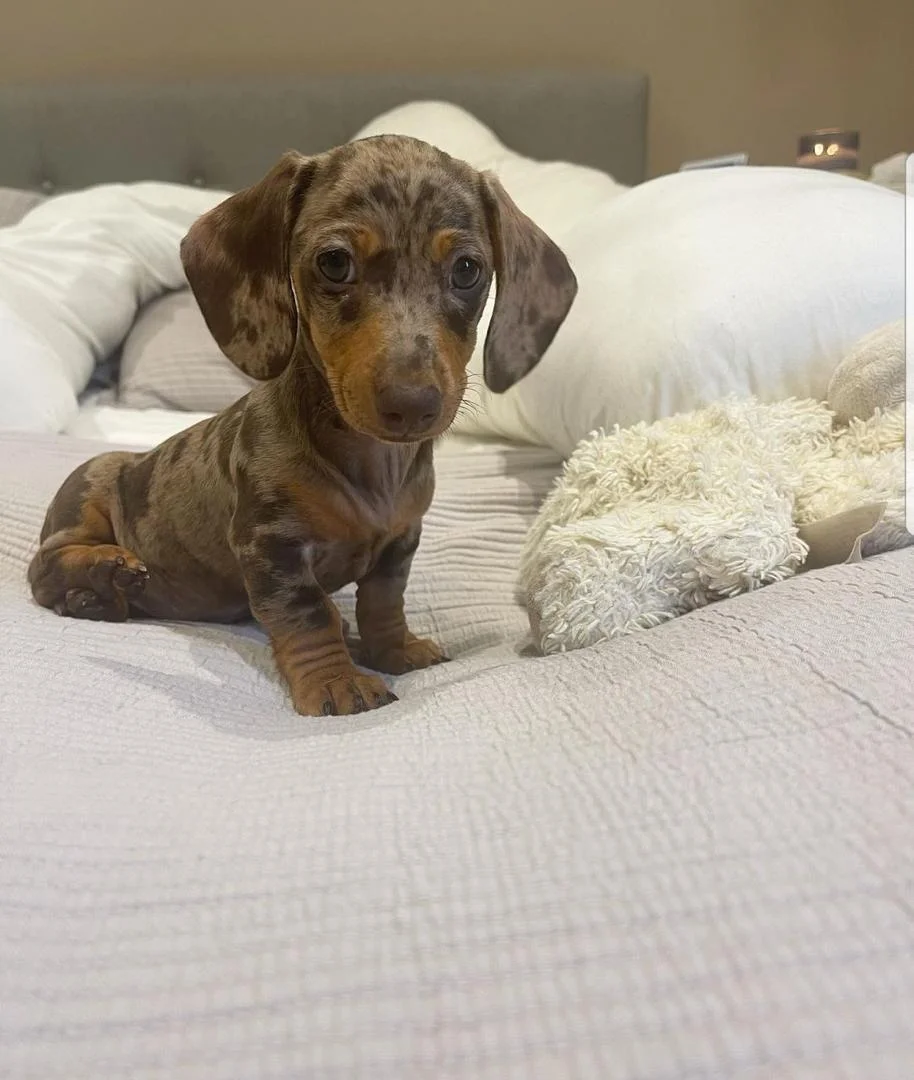
Welcome to puppy parenthood
Congratulations on your Evercrest puppy. The weeks ahead are equal parts delightful and exhausting, and almost everything that feels like a crisis at week two is normal. This guide covers the fundamentals; for anything it does not answer, call us.
Essential care
Nutrition
Choose a high-quality small-breed puppy food with a named meat as the first ingredient and an AAFCO statement on the bag. Small breeds burn energy quickly and have small stomachs, so quality matters more than quantity.
Change food gradually over a week, mixing increasing amounts of the new into the old. We will tell you exactly what your puppy has been eating so you can decide whether to switch at all.
Quick tips
- Three or four small meals daily, dropping to two by six months
- Fresh water available at all times, changed twice a day
- Weigh the food. Eyeballing it is how Dachshunds get heavy
Training
Start the day they arrive. Sit, down, come and a reliable recall are worth more than any trick. Positive reinforcement works; corrections mostly teach a Dachshund to be sneakier.
Consistency across the household matters enormously. If one person allows the sofa and another does not, the puppy will simply learn who to ask.
Quick tips
- Five to ten minute sessions, several times a day
- One word per command, used by everyone
- Socialise deliberately — people, surfaces, sounds, other dogs
Exercise
A useful rule for growing puppies is five minutes of formal walking per month of age, up to twice daily. Free play in a safe space on top of that is fine and mostly self-regulating.
Mental work tires a hound faster than distance. Scent games, snuffle mats and food puzzles do more for a restless Dachshund than an extra mile.
Protect the spine
- No jumping down from sofas or beds — use ramps or steps
- Avoid rough wrestling with larger dogs
- Lift with one hand under the chest and one under the hindquarters
Grooming
Grooming depends entirely on coat. Smooth coats need a weekly rubber-brush. Long coats need brushing every two or three days, with attention behind the ears and under the front legs. Wire coats need hand-stripping to keep their texture.
Bathe only when genuinely needed. Over-bathing strips the coat oils that keep the skin healthy.
Weekly checklist
- Brush teeth with dog toothpaste — daily is ideal
- Trim nails before you can hear them on the floor
- Check and clean the long, low-hanging ears
Veterinary Care
Register with a vet before your puppy arrives and book the first appointment within seven days — that visit also activates our health guarantee.
Stay on schedule with vaccinations, worming and parasite prevention, and learn what normal looks like for your dog so you notice quickly when it changes.
Watch for
- Reluctance to jump, use stairs, or a hunched back
- Changes in appetite, thirst or energy
- Bad breath, tartar or pawing at the mouth
A Safe Home
Puppy-proof before arrival, not after. Remove toxic plants, secure cables, close off stairs with a gate and pick up anything small enough to swallow.
Give the puppy one place that is entirely theirs — a crate or bed in a quiet corner — and teach the household to leave them alone when they are in it.
Safety checklist
- Stair gates at the top and bottom, from day one
- Cleaning products and medication behind closed doors
- Chew toys sized so they cannot be swallowed whole
The part nobody tells you
The first fortnight is the hardest, and then it is not. Sleep improves, house training clicks, and the small animal who woke you at three in the morning turns into a dog who follows you from room to room for the next decade and a half.
Feed sensibly, protect the back, train kindly and take the vet appointments seriously. That is genuinely most of it — and we are here for the rest.
Quick reference
Feeding
Exercise
Grooming
Vet Visits
Stuck on something?
Ask us. We would far rather answer a small question early than a big one later.
Contact Us